

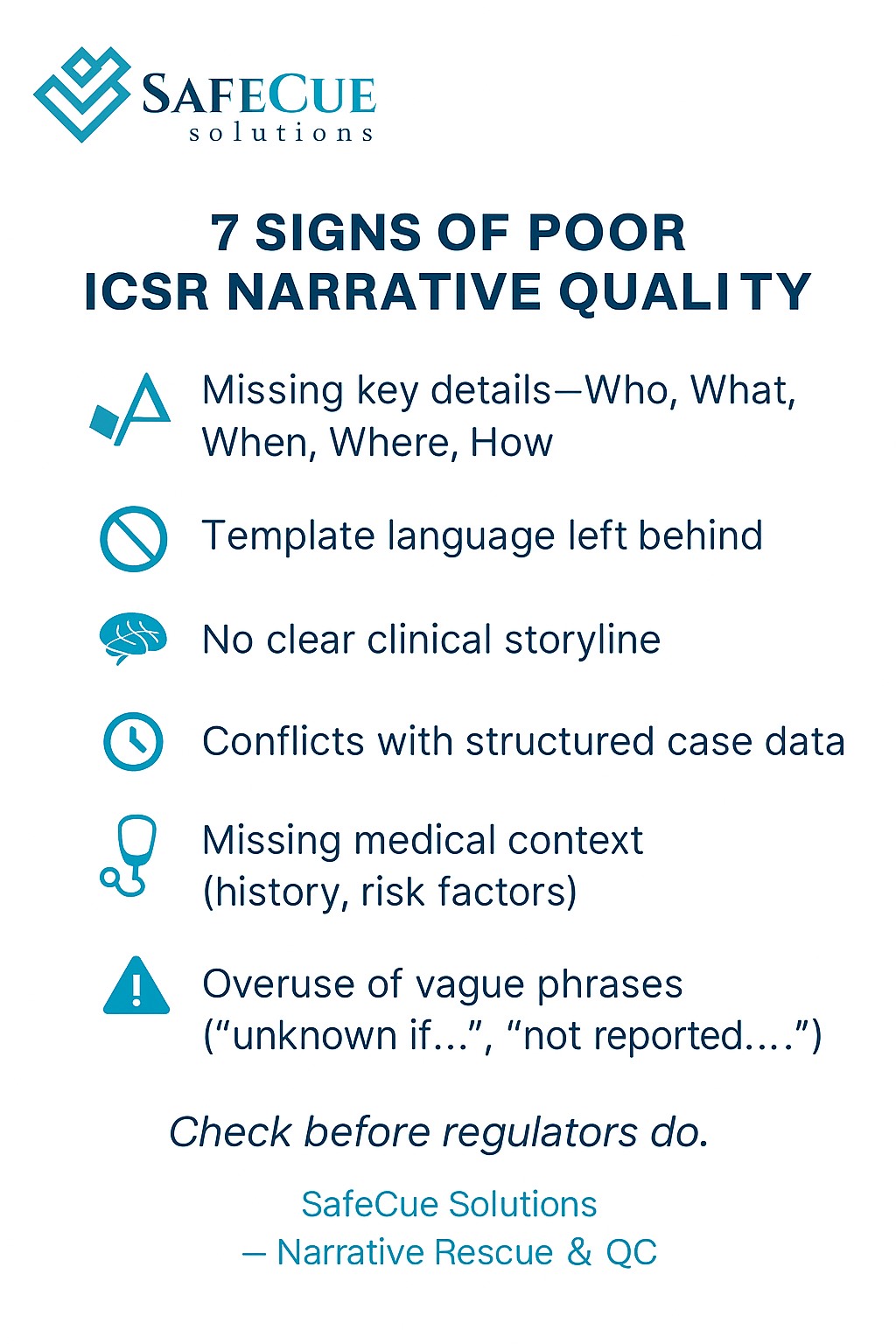
How to Recognize Poor ICSR Narrative Quality Before Regulators Do
In the fast-paced world of pharmacovigilance, ICSR narratives are more than just a formality—they are the storytelling backbone of patient safety data. A well-written narrative ensures that the safety profile of your product is clear, credible, and defensible.
But too often, poor-quality narratives go unnoticed until it’s too late—surfacing during audits, inspections, or after a regulatory query lands in your inbox.
At SafeCue Solutions, we help companies avoid this risk every day. Here are key signs that an ICSR narrative may be falling short—before feedback arrives from regulators.
⸻

1. Missing the “Who, What, When, Where, and How”
A high-quality narrative answers these critical questions clearly:
• Who experienced the event?
• What happened, in clinical terms and lay context?
• When did it happen in relation to suspect drug exposure?
• Where did it occur (setting, country, clinical context)?
• How was the event managed, and what was the outcome?

Narratives that skip details or confuse timelines will raise red flags.
⸻

2. Template Language Left Behind
It happens more than you’d expect—copy-paste errors, irrelevant template placeholders, or generic phrasing like:
“If applicable, describe the outcome…”
These are instant signals to regulators that the narrative wasn’t properly tailored to the case.
⸻

3. No Clear Clinical Storyline
Poor narratives often feel like disconnected bullet points stitched together.

A strong narrative flows logically: exposure → event onset → treatment → outcome.

Weak narratives confuse reviewers with scattered or chronologically inconsistent information.
⸻

4. Timeline Gaps or Ambiguities
• Are start dates, stop dates, or event onset dates missing?
• Is it clear when the patient started the suspect product relative to the adverse event?
Even one missing date can undermine causality assessment and raise regulatory concerns.
⸻

5. Inconsistent with Structured Data
If the narrative contradicts the data fields (e.g., stating “patient recovered” when the outcome is listed as “fatal”), it creates major compliance risks.
A good QC step is always cross-checking:
• Narrative

CRFs
Case form fields
⸻

6. Lack of Medical Context
A poor narrative might mention an event like “hepatic failure” without explaining:
• Relevant medical history (e.g., alcohol use, hepatitis, comorbidities)
• Concomitant medications that could be confounders
• Risk factors that frame causality properly
⸻

7. Overuse of Non-Committal Language
Phrases like:
“It is unknown if…” or “The reporter did not provide…”
—used excessively—signal a rushed or surface-level narrative. While sometimes necessary, overuse suggests the writer didn’t sufficiently analyze the available data.
⸻

The SafeCue Solution: Proactive Narrative Rescue
Narratives shouldn’t become a compliance risk after submission. We believe the best defense is a proactive one. At SafeCue Solutions, we specialize in rescuing narratives—whether that’s through case-level rewrites, quality control reviews, or setting your team up with better standards and training.
⸻

Final Thoughts
If you spot any of these warning signs in your current narratives, it’s time to act before regulators do. Reach out to SafeCue Solutions—our narrative specialists are ready to help you tell the right safety story, every time.
⸻